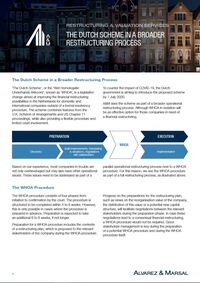
On 11 May, Dutch parliament will decide whether to fast track the introduction of the “Wet Homologatie Onderhands Akkoord’, known as ‘WHOA’ or the Dutch Scheme. The legislation would lead to a major improvement of financial restructuring possibilities in the Netherlands for domestic and international companies outside of a formal insolvency procedure.
If successful, the proposed scheme will be introduced by 1 July 2020 combining features from the U.K. Scheme of Arrangements and US Chapter 11 proceedings, while also providing a flexible procedure and limited court involvement.
Based on A&M’s experience, most companies in trouble are not only overleveraged but may also have other operational issues. These issues need to be addressed as part of a parallel operational restructuring process next to a WHOA procedure. For this reason, A&M sees the WHOA procedure as part of a full restructuring process.
Click here to download our insights document.
Endgame for Europe's Chemical Industry
February 24, 2026
Test article for Germany
Alvarez & Marsal Expands Infrastructure & Capital Projects Offering Into Canada With The Integration of LQ Consulting And Management
February 9, 2026
Leading global professional services firm Alvarez & Marsal (A&M) announced the integration of LQ Consulting and Management with A&M’s INFRA practice in Canada and appointed Pierre Légaré as Managing Director and Leader of INFRA Canada along with Senior Directors Arshya Qureshi and Gordon Lung.
REDEFINING LEADERSHIP: THE EVOLVING RESPONSIBILITIES OF DIRECTORS
January 23, 2026
More than half of Australia’s directors are feeling uncertain about the economy (Source: AICD). And let’s be honest—who can blame them? We’re in the middle of a perfect storm. Inflation, though stabilising, hasn’t given us a break; interest rates are twitchy, and consumer spending—well, what spending?
This is testing article, Please ignore this
December 23, 2025
Lorem Ipsum is simply dummy text of the printing and typesetting industry. Lorem Ipsum has been the industry's standard dummy text ever since the 1500s, when an unknown printer took a galley of type and scrambled it to make a type specimen book.