
A look into Tesla's Cybercab rollout and the state of driverless ride sharing
This edition of the Automotive Industry Spotlight will focus on Tesla's Cybercab launch and what recent developments signal about the broader state of driverless ride sharing.
In industry news:
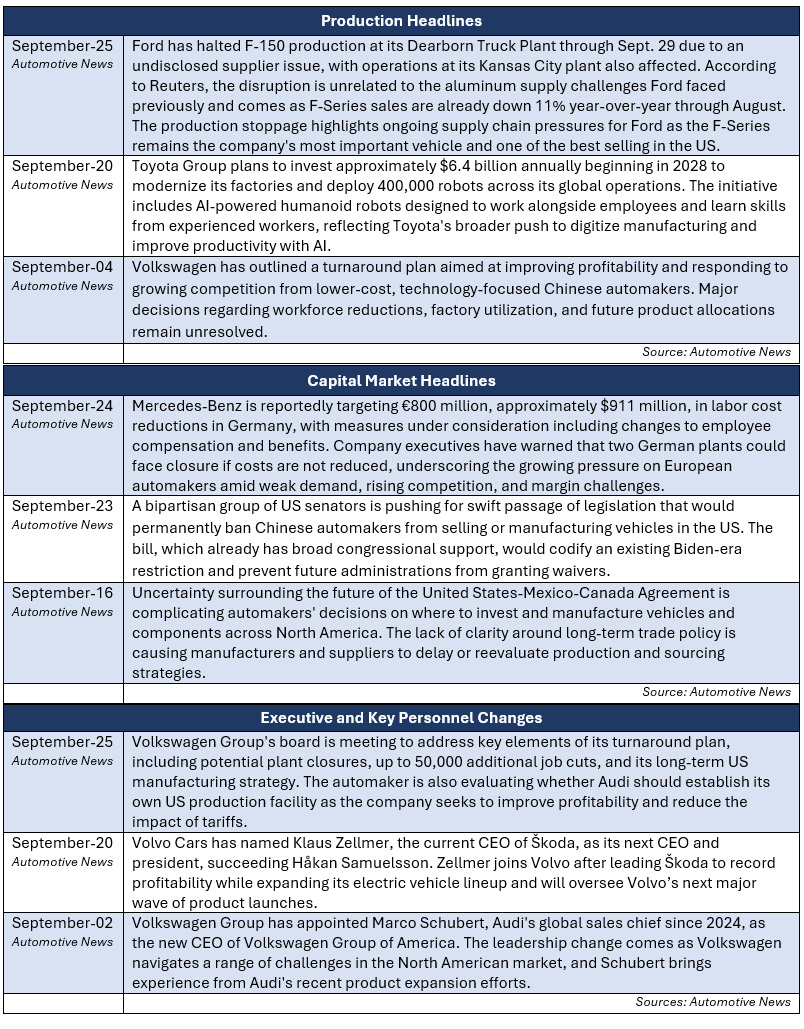
- Ford F-150 Production Disruption – Ford has suspended F-150 production at its Dearborn Truck Plant through September 29 due to an undisclosed supplier issue, with operations at its Kansas City plant also impacted.
- Toyota Factory Automation Initiative – Toyota Group plans to invest approximately $6.4 billion annually beginning in 2028 to deploy 400,000 robots across its global factories, including AI-powered humanoid robots.
- Tesla FSD Approval Momentum – Slovenia has approved Tesla's Full Self-Driving (FSD) technology ahead of a potential EU vote that could expand regulatory approval of the system across Europe.
In regulatory news:
- California Emissions Standards Litigation – A federal court has challenged the Environmental Protection Agency’s (EPA's) handling of California vehicle emissions waivers, directing the agency to revisit aspects of its approach that judges criticized as regulatory "gamesmanship."
- Tesla FSD Testing in France – France has launched testing of Tesla's Full Self-Driving (FSD) system ahead of a potential EU regulatory decision on the technology. The trials mark a significant milestone in Tesla's push to expand FSD in Europe.
- Defective Airbag Recall Concerns – US regulators are increasing scrutiny of defective Chinese-made replacement airbag inflators after a recent crash was linked to the 11th related fatality nationwide.
Industry Focus: Tesla's Cybercab and the State of Driverless Ride-Sharing
On September 3, 2026, Tesla began commercial service for its Cybercab, a two-seat robotaxi built for full autonomy, in Austin, Texas. The launch caps nearly two years of anticipation since the vehicle was first unveiled, and it marks Tesla's most direct entry into the driverless ride-sharing market. In the weeks since, the story has continued to unfold; regulators have taken a closer look at how the Cybercab was safety certified, and Waymo has extended its lead in the driverless ride-sharing race with new cities and its first market abroad. Together, these developments offer a useful read on how close the industry is to real commercial scale and how much work remains.
Cybercab Launch in Austin
The Tesla Cybercab looks and drives differently than anything Tesla has put on the road before. It has two seats and no steering wheel, pedals, or mirrors, relying entirely on Tesla's full self-driving software to operate. This is a meaningful departure from Tesla’s Model Y robotaxis, which can still be driven like a normal car if needed, that are already on the road. The Cybercab is Tesla's first vehicle built from the ground up with no path back to a human driver, and that is precisely why regulators are paying close attention to it. For now, rides are limited to Austin, the same service area already covered by Tesla's existing Model Y robotaxi fleet, and the Cybercab fleet itself is a small fraction of that footprint. Tesla's total robotaxi fleet registered in Texas, roughly 420 vehicles, still trails Waymo's registrations in the state by a wide margin. [1][2] Tesla has since begun staging Cybercabs and Model Y robotaxis at a facility in Houston, suggesting a second city may be next, though the company hasn't committed to a timeline or named where the Cybercab will go from here. [3]
Regulatory Scrutiny Escalates
The Cybercab's debut drew an immediate response from federal safety regulators. Within hours of Tesla charging its first fares, the National Highway Transportation Safety Administration (NHTSA) opened an inquiry into how a vehicle without a steering wheel or pedals was certified to meet safety standards written for human drivers. The situation echoes what Amazon's Zoox went through with a similarly designed robotaxi: years of review and a full fleet recall before Zoox ultimately secured an exemption to operate commercially. [4] How Tesla's response to the inquiry is received will say a lot about how much latitude regulators are willing to give purpose-built autonomous vehicles and how quickly the Cybercab can expand beyond Austin.
Competitive Landscape
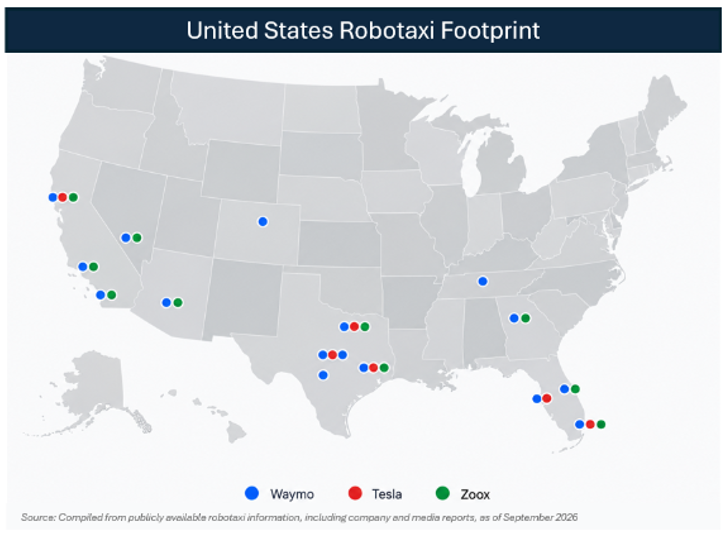
While Tesla works through its regulatory questions, it's worth stepping back to see who else is in this race. Three companies represent the leading edge of commercial driverless ride sharing in the US: Waymo, the clear scale leader; Zoox, Amazon's purpose-built entrant that has been expanding more quietly since 2020; and Tesla, the newest and most narrowly deployed of the three.
Waymo added Las Vegas as a service area in September, bringing its US footprint to 15 cities, and its fleet has grown past 4,000 vehicles. [2] The company also announced its first market outside the US, with a Tokyo launch planned for next year. Waymo's approach recently gained some independent validation as well. A safety study found its driverless vehicles were involved in meaningfully fewer crashes than human drivers across most of its markets, though comparable data doesn't yet exist for Tesla's or Zoox's driverless fleets. [5]
Zoox began testing in Houston and San Diego in September, bringing its US footprint to 12 metro areas, and the company launched full commercial service to Las Vegas's Harry Reid International Airport. Public riders remain limited to a handful of those markets, but Zoox secured temporary NHTSA approval to operate up to 2,500 of its purpose-built vehicles commercially, a step that Tesla’s Cybercab will still need to clear to match its pace. [6]
Together, these milestones underscore how differently each company is approaching scale. Waymo has reached a footprint that looks durable, and Zoox is still building toward broad public access. Tesla is betting on a different lever: full self-driving software already runs on roughly 1.5 million consumer Tesla vehicles, and Tesla is counting on that fleet's driving data to help its purpose-built robotaxis scale quickly once Cybercab's regulatory questions are resolved.
Looking Ahead
The coming weeks should clarify a lot about where the Cybercab goes from here. Tesla's response to NHTSA, due by the end of September, will be an early test of whether self-certification remains workable for vehicles built without a driver in mind, or whether the company will need to pursue the kind of extended review Zoox went through before it could scale. Either way, the broader shape of the driverless ride-sharing market is becoming clearer: one operator has reached a scale that looks durable, while other entrants, including Tesla, are still working through both the technology and the regulatory path needed to get there. How quickly that gap closes will be one of the more important storylines to watch.
Sources
[1]. Yahoo!Finance: Robotaxis Don’t Go Home at Night… and That’s Creating a New Real Estate Gold Rush
[2]. Yahoo!Finance: Waymo is scaling fast: Here’s what the fleet data shows
[3]. Yahoo!Finance: Huge Number of Tesla Robotaxis Spotted and Ready to Be Used in Texas
[4]. TechCrunch: Feds launch investigation into Tesla’s Cybercab deployment
[5]. IIHS: Waymo’s driverless cars crash less often than people
[6]. TechCrunch: Amazon’s Zoox expands its robotaxi service to Las Vegas airport
Additional insights are included below.
Industry Update
August new-vehicle inventory declined to approximately 2.68 million units, down from 2.73 million in July and down 1.8% from a year earlier, marking a third consecutive monthly decline. Industry days' supply fell to 73 days, down from 77 days in July, primarily reflecting a pickup in sales pace month over month. Days' supply is now at its lowest level since April 2025.
Pricing ticked modestly higher as inventory tightened. The average listing price rose to around $49,500, up 0.6% from July and 1.9% year over year. Supply remains most constrained in the market's most affordable segments: vehicles priced at $30,000 or below carried just 54 days of supply compared with more than 90 days for vehicles priced above $60,000. Notably, model-year 2027 vehicles represented 12.4% of available inventory at month-end, more than double July's 5.6% share. The rollout remains well behind last year's pace, indicating automakers continue to take a measured approach to the model-year transition heading into the fall selling season. [1]
Source
[1]. Cox Automotive: Retail Demand Remains Strong as New-Vehicle Inventory Declines in August
Regulatory Landscape
California Emissions Waiver Dispute – A US court criticized the EPA's handling of California vehicle emissions waivers, faulting the agency’s attempt to reclassify six existing waivers as new rules in order to give Congress an opportunity to repeal them. The court called the maneuver “gamesmanship” and directed the EPA to reverse its course. The decision adds uncertainty to the implementation of California's emissions policies and the broader regulatory environment facing automakers. [1]
Tesla FSD Testing in France – France has begun testing Tesla’s FSD technology as European regulators move closer to deciding whether to permit broader deployment of advanced driver-assistance systems across the EU. The tests represent a significant milestone in Tesla's effort to expand FSD availability in Europe, with a favorable regulatory outcome potentially accelerating adoption of autonomous driving features across the region. [2]
Airbag Inflator Safety Concerns – A defective Chinese-made replacement airbag inflator has been linked to an 11th death in the United States following an August 27 crash that NHTSA described as otherwise survivable. NHTSA had already banned the import and sale of the inflators earlier this year, but the latest fatality has renewed scrutiny of the products, which have been attributed to Chinese manufacturer DTN although the company disputes that it produced them. The inflators can rupture during deployment and propel metal fragments into the passenger compartment, creating a serious safety risk. Because the components were installed as aftermarket replacement parts rather than original equipment, NHTSA is intensifying efforts to encourage owners of previously repaired vehicles to have their airbag systems inspected. [3]
Sources
[1]. Court signals opposition to EPA in California waiver fight - Automotive News
[2]. France tests Tesla FSD as EU approval decision approaches - Automotive News
[3]. Defective Chinese airbag inflator kills 11th person in the U.S. - Automotive News
Stay connected to industry financial indicators and check back in October for the latest Auto Industry Spotlight.
Automotive Industry Spotlight Archive


