
A Look into United States-Mexico-Canada Agreement Renewal Negotiations
This edition of the Automotive Industry Spotlight will focus on recent developments regarding the United States-Mexico-Canada Agreement (USMCA) renewal and ongoing negotiations.
In industry news:
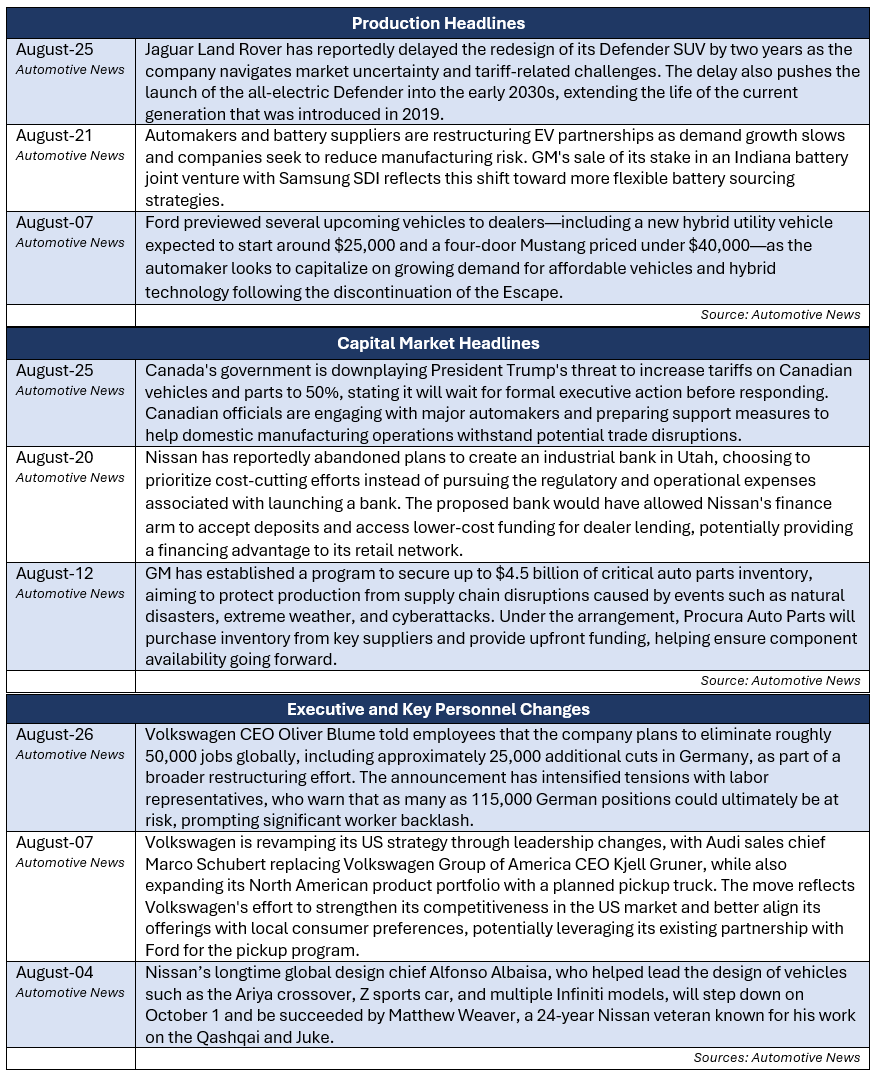
- Jaguar Land Rover Defender Strategy – Jaguar Land Rover has reportedly delayed the redesign of its Defender SUV by two years, pushing back the launch of an all-electric version as the company navigates tariff uncertainty and softer-than-expected electric vehicle (EV) demand.
- General Motors (GM) Supply Chain Resilience – GM established a program to guarantee up to $4.5 billion of critical parts supply, aiming to reduce production disruptions from events such as natural disasters, extreme weather, and cyberattacks.
- US-Canada Auto Trade Tensions – Canada dismissed President Trump’s threat to increase tariffs on Canadian-made vehicles and parts to 50% while monitoring potential trade actions and assessing the impact on North American automotive manufacturing.
In regulatory news:
- GM Vehicle Safety Review – The National Highway Transportation Safety Administration (NHTSA) opened an investigation into nearly one million GM pickups and SUVs following reports of engine failures, adding regulatory scrutiny to one of the automaker’s key vehicle platforms.
- Chinese Vehicle Market Access – The American International Automobile Dealers Association (AIADA) called for a ban on Chinese automakers selling or manufacturing vehicles in the US, citing support for stronger restrictions on Chinese automotive companies.
- Canada Vehicle Emissions Policy – Canada plans to continue aligning its vehicle emissions framework with prior US standards established during the Biden administration despite the Environmental Protection Agency (EPA) rolling back federal emissions regulations.
Industry Focus: USMCA Negotiations
On July 1, 2026, the Trump administration declined to renew the USMCA for a 16-year extension. Mexico and Canada each signaled support for renewal, but the US decision to not renew implies the agreement would be subject to annual reviews through 2036. For the automotive industry, this shift from a stable, multi-decade framework to recurring annual negotiations presents disruption to the environment that has guided North American manufacturing for the past six years.
The Framework Under Review
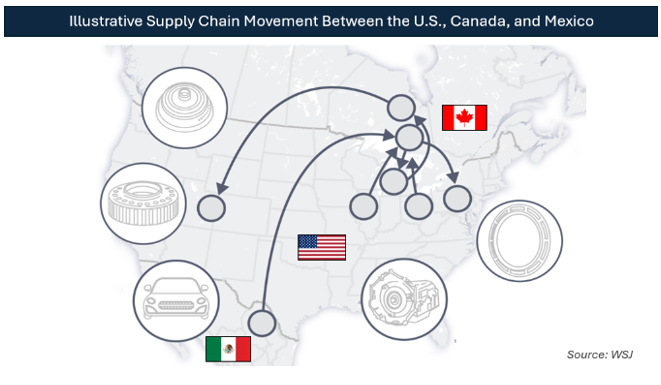
The USMCA replaced the North American Free Trade Agreement (NAFTA) in 2020 and governs roughly $2 trillion annually in goods and services between the three countries. [1] For automakers and suppliers, the agreement established rules of origin that incentivize North American production. Since 2020, these rules have anchored capital planning and long-term investment decisions. Original Equipment Manufacturers (OEMs) committed billions to battery plants, assembly lines, and supplier networks with confidence that the trade environment would remain stable for 16 years, aligned with vehicle development cycles and long-term capital planning.
Current State of Negotiations
Trade negotiations continue to be a fluid situation and talks between the US and Canada broke down on August 21. The US had reportedly been prepared to lower tariffs on Canadian light vehicles to 15%, but disagreements over medium and heavy-duty vehicles derailed the deal. The White House then imposed new tariffs on roughly $20 billion of Canadian goods and threatened 50% duties on Canadian vehicles and parts starting January 1, 2027. [2]
Canada responded on August 24 with matching tariffs on about $20 billion of US imports, effective September 8, alongside a $5.4 billion support package for affected businesses. [3] Prime Minister Mark Carney has said Canada will return to the table only if the Trump administration changes its approach, and no further talks are scheduled.
For automakers and suppliers, day-to-day tariff exposure is largely unchanged. USMCA-compliant vehicles remain taxed at 25% minus US content, and compliant parts still cross the border duty-free. [2] The US and Mexico are scheduled to meet again in September while the Canadian track has stalled. That divergence raises the concern of two separate sets of rules governing North American production rather than one.
Why Annual Uncertainty Reshapes Investment Decisions
The automotive industry operates on 10-year planning horizons. Battery plants, assembly facilities, and supplier networks require capital commitments years before production begins. When the trade framework governing those decisions is subject to annual review, the industry faces a structural problem.
Industry executives have stated their position plainly: the industry cannot plan confidently when trade rules may shift every 12 months. [4] Annual reviews could delay machinery purchases, plant expansions, and reshoring decisions by extending uncertainty over future trade rules. For example, Honda, who is approaching full capacity in North America, recognizes the need for an eighth assembly plant by 2030. However, executive leadership conditioned the investment on trade policy clarity. "If there is no USMCA agreement in the future, we may have to change our direction," Honda executive Noriya Kaihara stated in Washington on August 25. [4] The hesitancy by Honda represents a likely recurring theme: OEMs and the supplier base are deferring large investment commitments until policy uncertainty resolves. Companies can absorb temporary uncertainty, but they struggle to commit capital when policy clarity extends only 12 months at a time. The result is a pause in investment sequencing and a wait-and-see approach slows job creation, site selection, and capability development.
Looking Ahead
The USMCA has supported significant investment since 2020. That momentum was built on framework stability. Negotiations are ongoing, and industry groups have called for a resolution that restores clarity to the trade environment. Whether negotiators can reach agreement in the near term or whether manufacturers will simply adapt to a decade of annual reviews remains an open question with meaningful implications for regional competitiveness and employment.
Sources:
[1]. Office of the United States Trade Representative: United States-Mexico-Canada Agreement
[2]. AutoNews: Spiraling U.S.-Canada trade war puts auto investments in limbo
[3]. AutoNews: Canada doubles countertariffs on U.S. steel, aluminum to 50%; billions in aid to help businesses hurt by duties
[4]. AutoNews: USMCA review puts North American auto industry, investment in limbo
Additional insights are included below.
Industry Update
July new-vehicle inventory remained relatively stable at approximately 2.7 million units, down modestly from June but largely unchanged compared to the prior year. Industry days' supply decreased to 75 days, down from 80 days in June, primarily reflecting a pickup in sales pace.
Pricing remained stable and incentive spending continued to decline. The average listing price held at $49,249, unchanged from June and up only 1.6% year over year, while incentive spending fell to $3,192 per vehicle, or 6.4% of average transaction price. The sustained decline in both incentives and inventory alongside stronger sales suggests a market moving toward better balance, with demand absorbing supply without creating upward pressure on prices. Notably, automakers are taking a measured approach to model-year 2027 introductions, with dealers holding roughly half as many new model-year vehicles as they did at the same point last year, indicating continued inventory discipline heading into the fall selling season. [1]
Source:
[1]. Cox Automotive: July New-Vehicle Inventory Declines as Stronger Sales Outpace Replenishment
Regulatory Landscape
Vehicle Safety Oversight: Federal regulators continue to focus on vehicle safety and reliability, with NHTSA opening an investigation into nearly one million GM pickups and SUVs following reports of engine failures. The probe underscores the ongoing emphasis on quality, safety performance, and defect monitoring across the automotive industry. For manufacturers, large-scale investigations can increase compliance costs, create reputational risk, and potentially lead to recalls or other corrective actions. [1]
Chinese Automotive Market Restrictions: Industry stakeholders are increasingly advocating for tighter restrictions on Chinese vehicle manufacturers operating in the US. The AIADA has called for a ban on Chinese automakers selling or manufacturing vehicles in the US, reflecting broader concerns surrounding economic competitiveness, national security, and supply chain dependence. Continued policy momentum in this area could further limit market access for Chinese brands and influence strategic investment decisions across the industry. [2]
North American Emissions Policy Divergence: Canada is moving forward with vehicle emissions standards aligned with prior US regulations established during the Biden administration despite recent federal deregulation efforts by the EPA. The divergence highlights the growing complexity of the North American regulatory environment, as automakers may be required to navigate differing emissions requirements across jurisdictions. Manufacturers will likely continue balancing compliance strategies across multiple regulatory frameworks while managing evolving environmental policy objectives. [3]
Sources:
[1]. GM pickups and SUVs probed by NHTSA over engine failures - Automotive News
[2]. AIADA calls for ban on Chinese vehicles - Automotive News
[3]. Canada reverts to Biden era after EPA kills tailpipe rules - Automotive News
Stay connected to industry financial indicators and check back in September for the latest Auto Industry Spotlight.
Automotive Industry Spotlight Archive


